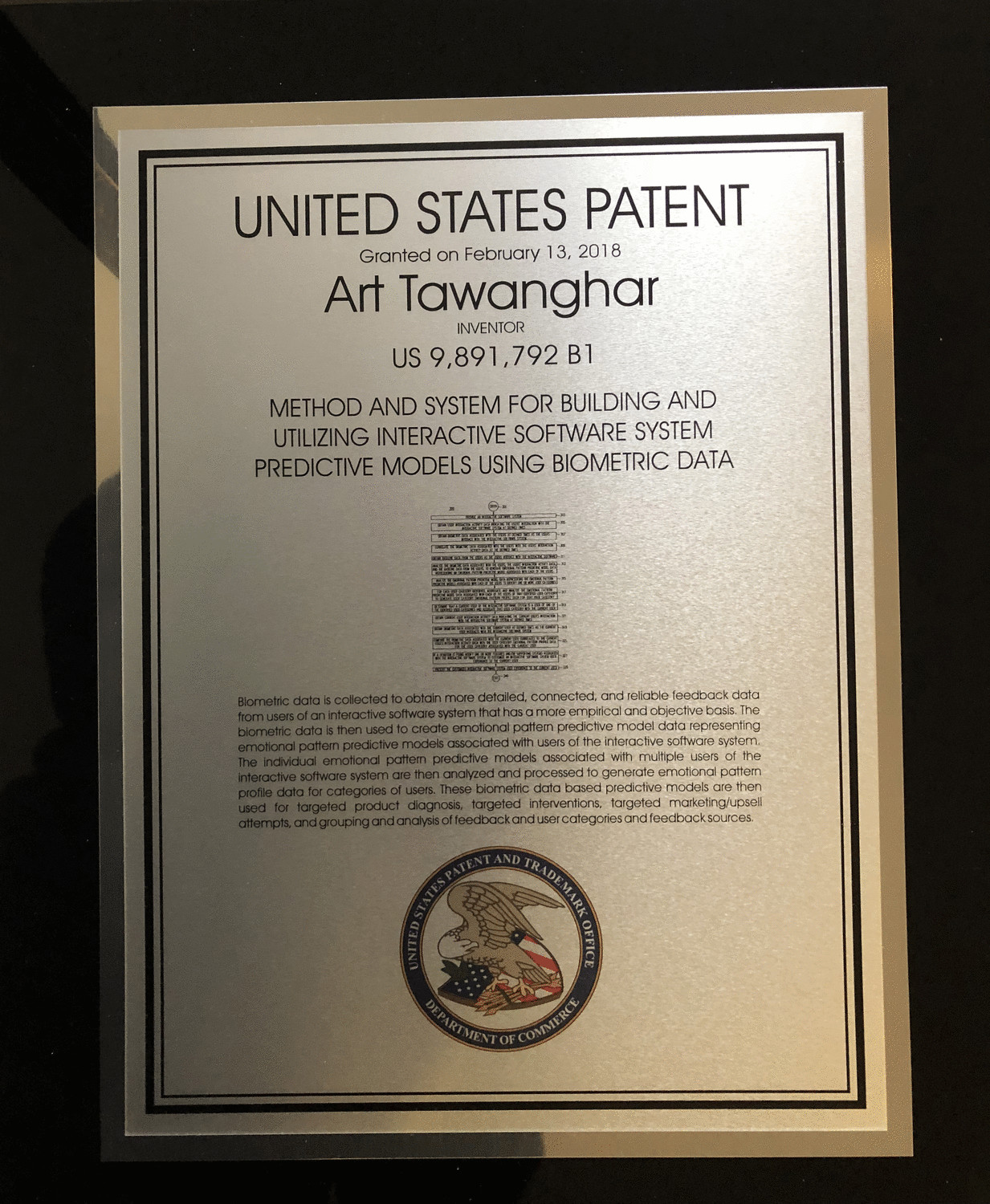
United States Patent · US 9,891,792 B1 · Granted February 13, 2018
Method and system for building interactive software using biometric predictive models.
Filed October 30, 2015 at Intuit Inc., where I was Senior Lead UI/UX Design Architect. Co-invented with Yao H. Morin, Vi Joy Caro, Massimo Mascaro, Luis Felipe Cabrera, Amir Eftekhari, Nankun Huang and Damian O'Malley. Assignee: Intuit Inc.
In one sentence
A method for building predictive models of how a person feels, from biometric signals like heart rate, facial and voice data, and using those models to compose the software interface they see next. On my side of the work I have always called it the digitization of emotion.
Why it exists
Analytics tell you what someone clicked. They never tell you that the person was confused, frustrated or anxious while clicking it. Every product decision I have ever argued for has come down to that missing signal. The patent describes a way to capture it as structured input rather than inference after the fact.
How it works
Biometric data is captured while a user interacts with a system. That data is correlated with interaction events to train an emotional predictive model for that user and cohort. A rule engine then composes the interface, pacing, density, sequence, tone, from the model's live prediction, rather than serving one static flow to everyone.
Where it points
Adaptive learning that slows down before a student gives up. Clinical tools that surface a simpler path when the operator's stress spikes. Financial products that stop pushing at the exact moment fear takes over. All of it is the same idea: software that adjusts to state, not just to input.
In the patent's own words
Biometric data is collected to obtain more detailed, connected and reliable feedback from users of an interactive software system, on a more empirical and objective basis. That data creates emotional pattern predictive models for individual users. Those individual models are then analyzed together to generate emotional pattern profiles for whole categories of users, and used for targeted product diagnosis, targeted interventions, targeted offers, and the grouping and analysis of feedback sources.
The thinking behind the patent runs directly into my current work on frequency-based therapy at iTorus, where the body's response is the product's primary signal.
See the iTorus App case study